
What Does WCAG Consistent Help (3.2.6) Require?
WCAG consistent help means that if contact details, a contact form or chat, a self-help page, or a chatbot repeats across a set of pages, it stays in the same order relative to the other content on each page. Success criterion 3.2.6 is Level A and new in WCAG 2.2. It does not require you to offer help.
ADASupport · Published and sources checked November 27, 2026
What does WCAG consistent help require?
Success criterion 3.2.6 applies when a page contains one of four kinds of help and that help is repeated on multiple pages within a set of web pages. In that case the help must occur in the same order relative to other page content on each page, unless the user initiates a change. It is Level A, so it is part of any WCAG 2.2 A or AA target.
W3C explains the goal as helping people find support for completing a task when support exists. People with cognitive disabilities, and anyone experiencing cognitive fatigue, are more likely to find help when it is always in the same place, and less likely to abandon the task.
Read the criterion in the WCAG 2.2 Recommendation and W3C’s Understanding Consistent Help page. Our WCAG 2.1 versus 2.2 comparison lists the other new criteria.
Which help mechanisms does consistent help cover?
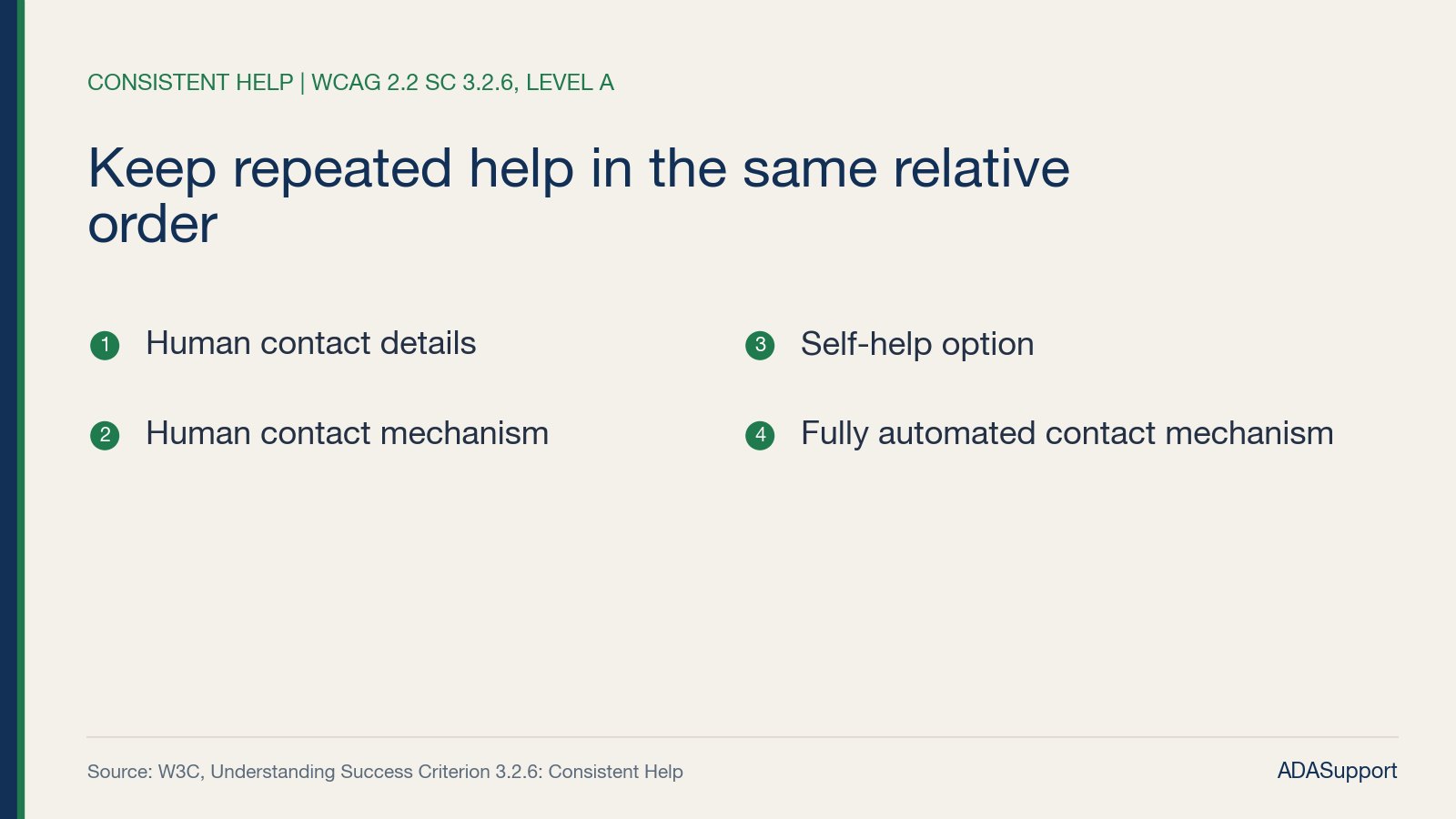
W3C lists four types: human contact details, such as a phone number, email address or hours; a human contact mechanism, such as a messaging system, chat, contact form or social media channel; a self-help option, such as an FAQ, a “How do I” page or a support page; and a fully automated contact mechanism, such as a chatbot. The listed order does not imply priority.
The criterion is about site-level help that users go looking for. It is separate from interface help tied to one control, such as contextual tooltips, spell checkers and form instructions. Those fall under other criteria, including labels or instructions.
For help attached to a single field, see our guide to labels or instructions.
Does consistent help mean every page needs a help link?
No. W3C states that the criterion does not require a site to provide a help mechanism, and that pages without help do not violate it. It only governs where help appears when you already repeat it across pages. Removing help to avoid the criterion defeats its purpose, but it is not itself a 3.2.6 failure.
Help that appears on only one page is not repeated, so the ordering rule has nothing to compare it with. The practical question is whether the help you do repeat, such as a header contact link or a footer support link, stays put.
What does same relative order mean in practice?
W3C measures order in the serialized page, the order of content in the code that assistive technology follows, within the same page variation, such as the same zoom level and orientation. Shared content that comes before the help item on one page should come before it on the others, and content after it should stay after it.
The exception covers changes the user starts in order to change layout, such as zooming, rotating the device or resizing the viewport. Moving from page to page is not a user-initiated change. Logging in or out usually is not either, unless it leads to a distinct set of pages. W3C notes that help moved only visually, with its serialized order unchanged, does not fail the criterion but is still unhelpful.
What counts as a set of web pages for consistent help?
A set of web pages is a collection with a shared purpose created by the same author, group or organization. Consistency is required within one set, not across different sets, so a checkout flow or a blog with its own navigation can place help differently from the main site.
W3C treats different language versions as different sets, and says PDFs and other downloaded documents are not part of the set they came from. Decide where each set begins and ends before you test, so you compare like with like.
How do you test a site for consistent help?
W3C technique G220, “Provide a contact-us link in a consistent location,” gives a three-step test. Confirm the pages form a set with repeated blocks of content. Identify which of the four help types is included or linked in a consistent location. Then, without changing the viewport size, check that the help is present on the other pages in that set.
In practice, pick a few templates, such as the home page, a content page, a form step and a search results page, at one viewport size. Note the repeated content just before and after each help item in the DOM or in a screen reader’s reading order, and compare. Pay particular attention to chat widgets and contact links that templates or third-party scripts insert in different places. W3C’s only listed failure is an inconsistent help location.
See W3C technique G220 for its test procedure and examples. Checking reading order is also part of a focus order review.
Does the ADA Title II web rule require consistent help?
The Title II rule for state and local governments adopts WCAG 2.1 Level AA, and Consistent Help was added in WCAG 2.2, so 3.2.6 is not part of the rule’s technical standard. ADA.gov says an interim final rule published April 20, 2026 moved the compliance dates to April 26, 2027 for entities serving 50,000 or more people, and April 26, 2028 for smaller entities and special district governments.
Many organizations still adopt WCAG 2.2 Level AA as their own target or in contracts, and consistent help is a low-cost change for most sites. Check which standard your own legal obligations, policies and contracts name.
Read the ADA.gov fact sheet on the Title II web rule and our Title II web rule overview.
This guide is educational and does not establish website conformance or provide legal advice.
Frequently asked questions
What does WCAG consistent help require?
When contact details, a contact method, a self-help option or a chatbot repeats across a set of web pages, it must appear in the same order relative to other page content on each page, unless the user initiates a change. It is WCAG 2.2 success criterion 3.2.6, Level A.
Which help mechanisms does consistent help cover?
Human contact details, human contact mechanisms such as chat or a contact form, self-help options such as an FAQ or support page, and fully automated contact mechanisms such as a chatbot.
Does consistent help mean every page needs a help link?
No. W3C says the criterion does not require a site to provide help. It applies only to help that is repeated across multiple pages in a set.
What does same relative order mean in practice?
It refers to the serialized order of content at the same zoom level and orientation. Repeated content before the help item on one page stays before it on the others, and content after it stays after it. Zooming, rotating or resizing is an allowed user-initiated change.
What counts as a set of web pages for consistent help?
A collection of pages with a shared purpose from the same author, group or organization. Different language versions are separate sets, and downloaded PDFs are not part of the set.
How do you test a site for consistent help?
Follow W3C technique G220: confirm the pages form a set, identify the repeated help, and check at one viewport size that it is present and in the same relative order on the other pages in the set.
Does the ADA Title II web rule require consistent help?
Not as part of its technical standard. The rule adopts WCAG 2.1 Level AA, and Consistent Help is new in WCAG 2.2. ADA.gov lists compliance dates of April 26, 2027 for larger entities and April 26, 2028 for smaller ones and special districts.